SPD

SPD vs just being sensitive

I have found that there appears to be a bit of confusion as to what it means to be sensory sensitive.

This confusion comes in many forms.

One area of confusion is often with children. I have read about and seen several instances where children display very poor behavior and their parent(s) explains that they have a sensory processing disorder (or something of that nature). While I don’t doubt that children with sensory sensitivities are prone to tantrums, meltdowns, and strange behavior or movements, SPD is becoming the name given to out-of-control children as an excuse for their behavior.

For example, I was in a bookstore and there was a young boy running around, making too much noise, taking things off the shelves, and generally causing mayhem and not caring what his mother had to say about it. I overheard his mother tell someone, “Well, he has the sensory processing thing, so…”

ok.

Who knows. Maybe this four year old boy did have sensory issues, but that shouldn’t be the excuse for his unruly behavior. Unfortunately, I see this a lot. It is becoming a default diagnosis for badly behaved children who don’t fit into other categories. It sounds like this:

“Your child likes to throw and break stuff? SPD.”

“Your child doesn’t listen to you at all? SPD.”

“Your child screams and punches you? SPD.”

This is very scary, considering the fact that I know how real SPD is, and that there are many children and adults with it, yet, it is becoming very much like ADHD in that it is being overly-used to compensate for lack of decent parenting or other issues in children. Then what happens is that people who DO have sensory issues are not taken seriously by the medical community.


The second area of confusion I’ve noticed is that there are people who don’t understand the concept of SPD and claim that every little thing that bothers or annoys them is because of a sensory processing issue. This is not true.

So let me give you a little demonstration:

Person WITHOUT SPD (a generally sensitive person):

Picture 5

TWO SECONDS LATER….

Picture 8


Person WITH SPD (a person with a sensory disorder):

Picture 9

TWO SECONDS LATER….

Picture 11


Can you see the difference?

A person who is generally sensitive to things may be bothered by something, but they have the ability  to push that sensitivity into the back of their mind. It no longer bothers them, and maybe they notice it….but they have the ability to remain calm and focus on other things despite this sensory annoyance.

A person who has SPD cannot stop perceiving sensory input (unless you are a hypo-sensitive person who needs MORE sensory input, than this little bit doesn’t apply to you, but you get the gist). The jeans are more than uncomfortable – they are disturbing and nothing else matters (NOT EVEN CUPCAKES) because my brain cannot stop being upset with the sensation of denim jeans on my legs. I cannot focus on anything else, and I definitely do not feel calm.

The latter story ends something like this:

Picture 21


I hope this post has helped clarify the difference between being annoyed by a sensation, and having a sensory problem. As usual, comments or discussion is welcome!

Also, here’s me and a giant cupcake:

Picture 22


-xoxo kelly

Occupational Therapy Adventure (for SPD)

Back in the glorious and confusing days of my childhood, I went to see an occupational therapist once a week to help with my sensory integration/processing disorder. His name was Frank, and he was a young guy who was extremely good looking (and now I CURSE myself because I never appreciated his attractiveness). I was obviously too distracted by the fact that I was 9 years old and more interested in the candy I received at the end of the session. Here’s a picture of Frank:

Picture 59

Alright, so that’s not exactly him.  It’s just a picture of a hot, shirtless guy I found on google, but let’s all pretend this is Frank.

————————— *————————–

Frank and I did LOTS of things in our short time together each week. He made me walk across a balance beam. This was to re-orient my vestibular system. I hated that. Frank would counter with some sort of ‘comforting statement’ like, “You’re only 2 inches off the ground.”

Picture 60

Not very comforting Frank. Your charm and wit didn’t amuse me.

Picture 61

Then he made me stick my hands in some glue and junk. We turned it green using dye, because why the heck not? It is very hard to describe to people who don’t have a sensory problem how it feels to do something that bothers your sensory problem, like sticking your hand in an icky substance. All I knew was that it was more than uncomfortable, and it created ugly signals in my brain. Therefore, I hated that too.

Picture 63

Picture 62

Sometimes he would suggest that I take a trip through the rainbow tunnel. You know the kind – a small, plastic tunnel that most children enjoying crawling through.

Picture 65

Not me though. My sensory system interpreted small, unfamiliar spaces as threatening:

Picture 66

Picture 67

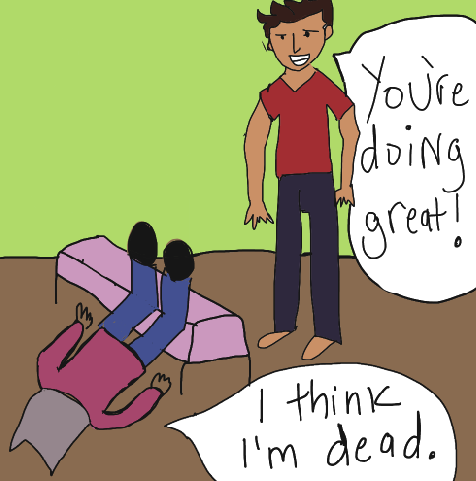
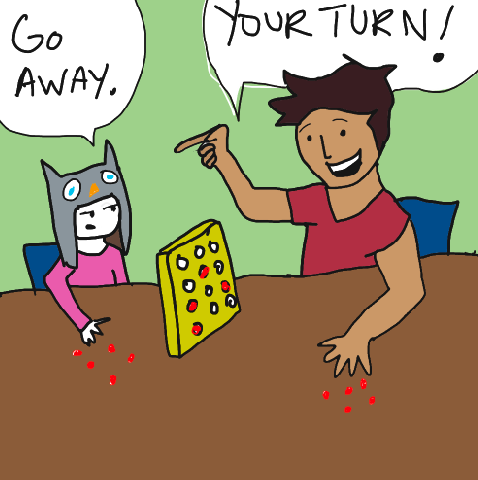
Then we played a stupid game, Connect Four. (Though not as stupid as the game I wrote about in my last post, Operation). I hated this the most because the sounds of the game were sudden and unpleasant. “This game is the pits,” I casually mentioned to Frank.

Frank chuckled at my statement, rested his perfectly featured face upon his hand, and encouraged me to finish the game. I couldn’t wait to tell my mom that she was paying a man to watch me play games that I didn’t even like. UNBELIEVABLE!

At this point of my OT session, I was slightly irritated with Frank. His smiley-ness and optimism was all too much for one girl to take.

Picture 64

But it was not over yet. Before my OT session with Frank ended, he would spend the last several minutes doing joint compressions (pressing my joints in gently) and brushing. The brush looks like this:

Sensory-Surgical-Brush1

It’s kind of FANTASTIC. (Although, those without sensory deep-pressure needs may find the brush against their skin to be unpleasant or just weird).

But who cares about those people, this brush is wonderful. After some deep pressure exercises, brushing, and joint compressions, I felt like a new girl. My hatred for Frank and his gorgeous smiling face seemed to vanish. Things got a little freaky:

Picture 68

Finally at the end of the session, I received my candy of choice and went on my merry way. This lasted for a few weeks or so, possibly longer, I don’t actually remember.

What I do remember is the absurdity of it all, and yet, my strange willingness to comply. I continued the compressions and brushing at home, but I don’t think that alone was enough to counteract the intense over-stimulation I was experiencing daily at school. Still, it was something, and definitely an experience I will never forget.

-xo Kelly

What the heck is Sensory Processing Disorder?

What the heck is Sensory Processing Disorder (SPD)? Also called Sensory Integration Disorder, or, as I call it, “My brain hurts from all the noises and lights and junk. I can’t function or anything, so I’m just gonna go to bed.”

I have found that nobody knows what SPD is, or just how deeply it can impact a person’s life. So darn it all! I’m making a post about it.

First, what the heck is sensory processing?

All of our senses are processed through our nervous system. That is, information is collected by our senses and sent to the brain where it is processed and sorted. Once this is done, your brain tells you how to respond to that information.

Second, what the heck is sensory processing disorder?

The disorder part comes into play when the act of sensory processing goes haywire. The sensory information gathered by the nervous system is not correctly interpreted by the brain, which results in numerous symptoms and behaviors.

Picture 1

Picture 2

What happens then?

Well my friends, if your brain does not know how to understand the information that it is being fed, you’d better believe that your response to it will also be quite messed up.

For people with sensory disorders, the resulting behaviors from a malfunctioning sensory system can vary tremendously. For some, they turn-inward and become still and quiet. For others, they lash out and have a loud, head-banging, arm-flailing meltdown.

Personally, my body shuts-down. I cannot talk (or make sense when I do speak), or walk straight. I am disoriented, irritable, crying, and feeling completely detached and ill. The environment becomes simply too much to process, so my brain tells me to just turn off for a while.

What’s it like living in a sensory world?

As you can imagine, living with SPD is, shall we say, challenging. All aspects of living on planet Earth require that you have a functioning sensory system. This is especially true in Westernized societies where sensory stimulation is considered fun and enjoyable. Of course, it becomes less fun and less enjoyable when your brain cannot process sensory signals the way they should. The world becomes unexpected, chaotic, frightening, and confusing. Basic aspects of life such as taking a shower, cooking dinner, seeing friends, working, going to school, watching television, or eating become a battle.

Imagine showering if the feeling of water dripping on you made you want to run for your life, or the water temperature feels painfully cold for you, but to everyone else and their brother, it feels fine.

Imagine going to school where the bus is bumpy and the radio is painfully loud, and the seats are shiny and feel different and ugly on your skin. The children are noisy and they move fast, and the teacher gives you white paper that hurts your eyes to look at. Your hand won’t hold the pencil, and the lines and words are jumping and moving. In gym, you are terrified of climbing the cargo net but you love crashing yourself into the blue cushy mats. In art, the thought of finger-painting makes you cry, but you love cutting paper or looking at shiny scissors.

Imagine you can’t get a job because the store has fluorescent lights and the customers are loud, and have screaming children. Your job requires you complete tasks for countless hours in a sensory-filled environment. Your clothes are itchy and too tight. The feeling of denim or fleece is awful, but you have to wear it. There’s a tag in the shirt that makes you want to scream.

Imagine you try to eat dinner but the smell of food makes you gag, and the feeling of the food in your mouth is unbearable. But you love to touch it with your fingers because your body tells you that that makes more sense, and it doesn’t hurt.

WHAT I’VE LEARNED…

Here I am now, age 22. My sensory disorder still plagues my life. When I reached my teen years, I found that therapy to help me cope with this disorder was virtually non-existent. They assumed that because I was 13 years old, I was able to do all the therapy on my own. I find this disturbing. It’s not like sensory problems go away. They can be managed and treated, but as of right now, this problem is not curable.

Even worse is the fact that the majority of people – both the general public and professionals – are either blissfully unaware of sensory disorders, or they don’t believe in them at all. Yes, you heard me. Many “professionals” do not think sensory problems exist.

When I ask people if they know about SPD, they respond either “no,” or the conversation goes like this:

Picture 5 Picture 7

Yeah like karate. UGH. BOW TO YOUR SENSEI.

SOME MORE THINGS I’VE LEARNED…

SPD is unrecognized in many people, aka: loads of people living with this disorder go undiagnosed. These people – young and old – have struggled their entire lives being deeply impacted by the challenges of living with sensory issues. I also feel that the sensory components in autism are severely neglected. In fact, I believe sensory problems are a huge factor in autism and the reason why autistic people behave the way they do. Autism is not just about communication problems.

Picture 4Picture 8

People generally don’t know much about autism (like the gentlemen in the illustration above) even though a huge number of the population live with this neurological disorder.

When researching autism, I found hardly any information about the connection to sensory problems. Everything was focused on communication and social skills. I recently read Temple Grandin’s newest book The Autistic Brain: Thinking Across the Spectrum. I was delighted to FINALLY see that she too noticed a huge lack of discussion about sensory problems in autistic people. Temple Grandin, you stole my hypothesis!!

I believe autistic behaviors stem from sensory overload (or under-load). Meaning, autistic people behave the way they do (social problems, little to no communication, meltdown, stimming, detachment/zoning out, need for routine, etc) as a way for their mind/body to cope with the sensory processing malfunction.

THIS, I feel is the most neglected part of autism, and it is neglected because sensory processing disorders are neglected across the board.

———————————————————–

Any thoughts/comments on SPD or related issues, leave a reply below. I love to see feedback or discussion! 🙂

xoxo kelly