aspergers

That’d be great

The following post has very little words and is mostly comprised of stupid illustrations. I’m living in the fog of depression today… for numerous reasons. In honor of these negative sensations, I’ve decided to sit down and make a post of things that’d be great to have right now. I’ve comprised a list of things that this world – my world – needs more of.  In no particular order:

1. an abundance of therapy dogs

Picture 18

Picture 35

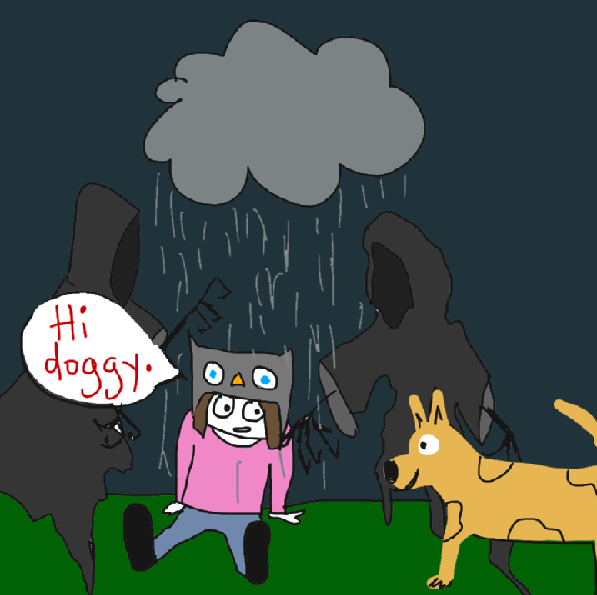
Therapy dog uses nerf gun power to mercilessly destroy dementors:

Picture 37

Picture 39

Picture 41

Yes, I am under there somewhere.


2. unexpected hot beverages and baked foods

Picture 40

OH GLOB. IT’S RAINING HOT COCOA AND MUFFINS. YES. YES.

Picture 44

MMMOOOORRRRRRRRREEEE

3. a better way to warm my ice-cold feet

Picture 47

Mini jacuzzi for each foot – yes please!

Picture 48


4. befriending dangerous wild animals, and just hanging out with them

Picture 49


5. better news – both in print and on television

What the news is today:

Picture 50

What the news should be:

Picture 51

And there you have it. I’m too depressed to write anything else. More importantly, where THE HECK is my herd of therapy dogs?

——————————-  ————————————–  ————————————

Important final note:

I was featured last month on the awesome SPD blog of Rachel S. Schneider, Coming to My Senses. I now command you all to go visit her blog! She also runs the facebook page, Sensory Processing Disorder Adult Support. She’s also super freaking amazing, and I drew her in my special way:

Picture 9

My post on her page, Warehouse Of Chaos , is about my trip to Best Buy with my mom.

Also, October is Sensory Processing Disorder awareness month. Rachel and I collaborated on a banner that looks a little something like this:

spdadult_4


It’s beautiful, we know.

If we worked on it in real life, we’d probably look like this:

Picture 52


xo kelly


Food Shopping Part 2: Big Decisions

I recently had another ridiculous food shopping experience. Afterward, I realized it would make an absolutely marvelous blog post. So ladies and gents, here we go:

After shopping with momsy for what seemed like several hours in preparation for a BBQ, we finally reach the frozen food aisle in the grocery store. We decided to pick a frozen meal to have for lunch because:

a. We never have frozen meals, therefor it would be different and exciting

b. We were tired and hungry and the frozen food is for the lazy.

Momsy quickly selects her frozen lunch. Some chicken pot pie thinger-whatever. Good for her, I thought to myself. Now it was my turn.

Let me remind everyone that again, this was the END of long day of shopping all over town, and if you have read my first post about food shopping (click here to read it) you will remember that food shopping can be a somewhat very extreme sensory nightmare.

So there I was, surrounded by freezers with dozens, if not HUNDREDS of options for what to have for lunch. I was overstimulated, COLD, tired, and very hungry.

Picture 5

I had to make a decision.

Picture 8

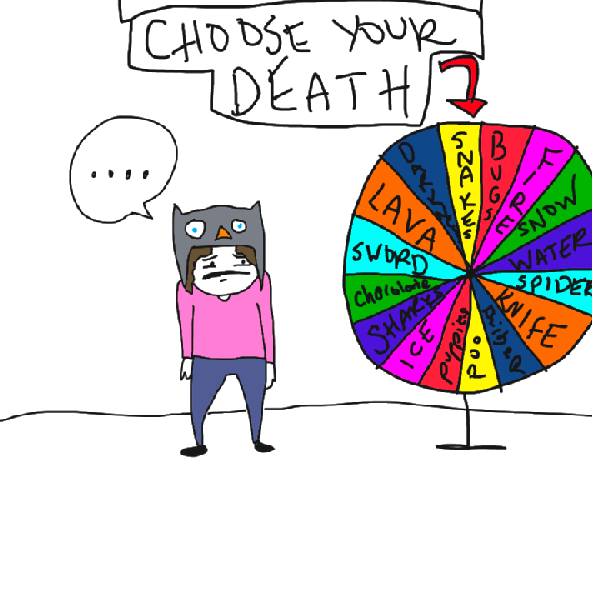
The task at hand was not really complicated: Choose a frozen meal to have for lunch. But it felt so much more intense:

Picture 11

(If you’re interested, the choices on the wheel are: lava, darkness, sword, chocolate, sharks, ice, puppies, poo, spider, knife, water, snow, fire, bugs, snakes, and bieber…whose name I spelled incorrectly. Go me).

Neurotypical people, like momsy, for instance, make decisions based on the fact that their brain does not struggle to process sensory information. All that comes naturally, so when they are in an overstimulating environment, their brain can focus on important decisions….like what to have for lunch.

Picture 18

Then there are people like me, whose SPD brain – when pushed to the brink – experiences difficulty when having to process anything other than sensory info because it’s so darn busy trying to process basic sensory info that it LITERALLY doesn’t have time for anything else. My brain was like:

aint-nobody-got-time-for-that

When deciding on what frozen thing I wanted, my brain would only respond by stating what it could process at the time:

Picture 19

Picture 20

GENIUS. UGHHHH

I remember standing in the aisle, pacing back and forth in front of the freezers and nothing was making sense. It felt like forever.

Picture 28

Picture 33


I couldn’t stand myself! How could I have possible graduated with honors from my university just months ago, yet I couldn’t pick a frozen lunch from a freezer? WTF, you guys. To hell with my SPD brain, I was hungry and incapable!

Luckily, my lady in waiting, momsy, was there and she recognized that I was overstimulated.

Picture 35

Picture 37

(Note: someone please make this frozen meal a reality. I don’t know about you, but I would buy Mr. Miyagi’s Kung Pow In Your Face Super Asian Noodles with SAUCE.)

And with that, all was ok. My brain accepted this box of asian cuisine and I was thankful that my decision making nightmare was over. I realized I had pushed myself too much all day, and my frozen meal meltdown – a seemingly random event –  was actually the product of too much overstimulation. I WAS SO OVERSTIMULATED THAT I COULDN’T RECOGNIZE THAT I WAS OVERSTIMULATED. Oh the irony!

Picture 48


xo kelly

What School Is Like For The Sensory Sensitive

It’s that time of year again, SCHOOL’S STARTING, and for the sensory sensitive, you know what that means…

images-1

earth dies screaming 3

Picture 49

2810447367_e6c054068e

screaming-rabbit

That’s right. Time to scream and run for the hills.

I thought I’d make a blog post about school, because for me and many of you reading this blog, school was an awful time. This post will be about my personal experience with school, but please realize that – like most things – our disabilities and experiences run on a spectrum. This means that my experience may be vastly different from yours, even if we have the same set of problems. Still, I’m sure everyone will relate to what I’m about to say.

Now that the mumbo jumbo is over, let’s take a trip down memory lane:

Preschool was a fun and exciting adventure for me. I got to leave my mom, and go to a land of noisy, confusing, miniature idiots. Preschool went like this:

Picture 18

Ma left me with the idiots, but only for a short while until she figured out that preschool just wasn’t for me. So I stayed home and focused on more important things:

gangsallhere

Soon enough, kindergarten arrived. Ready or not, I had to go. Well, I didn’t always go. Guess who had the award for most school absences ever? Yea, it was me. You guessed correctly, good job.

This pattern continued for like, ever.

I had my reasons….

Meanwhile on the school bus:

Picture 28

The students had faded to loud, swirly blobs that encompassed all my hatred of school bus traveling.

Meanwhile, in the classroom:

Picture 29

Picture 30

Picture 31

Picture 32

Sometimes, I became desperate and mentally deranged. Things got violent, sort of:

Picture 33

Picture 34

(Ok so, that last bit never happened. But you get the point… no pun intended).

Meanwhile, in the cafeteria:

Picture 62

Then middle school rolled along, and hey, it sucked too! Especially in 7th/8th grade, where my sensory sensitivities escalated for some reason. I still don’t know why that happened, I can only speculate what happened in my brain:

Picture 68


Picture 69


In middle school, I was diagnosed with Hyperacusis, which is the inability to tolerate normal sounds. When I say “normal,” I’m referring to the sound of someone’s voice, or the sound of a car/bus passing, or the sound of a chair being pushed under a desk.

My other senses were heightened as well – just as they always were – but my noise intolerance dominated my life. It was around this time that I turned to drawing as a source of coping.

In high school, life suckage reached an all time high. The expectation of me getting through the day was flawed and destined for failure.

The idiots from preschool were basically the same:

Picture 15


I began to think things:

Picture 17

There was forced learning collaboration with students I’d wish to avoid at all costs:

Picture 47


Picture 70


There was also lockers slamming, constant switching of classes, 7+ hours of constant sensory bombardment, and the expectation to perform academically, socially, etc.  Also…FIRE DRILLS. I’m lucky to have survived, honestly.

Picture 72


Looking back at my time in school, I see a blurry mess of anxiety, stress, homework, noise, and tiny moments of joy. I know the same can be said for everyone living with sensory sensitivities or full-blown SPD. Luckily, times are changing and society is becoming more aware and more tolerant of our unique set of circumstances and needs. Who knows, maybe one day I will start the first SPD Academy, and school will be a freakin’ great time for everyone.

xo kelly

Highly Sensitive Person vs Sensory Processing Disorder

I’ve been basically dying to make this post for a long time:Picture 34

See, I told ya.

The more I read online about Sensory Processing Disorder (SPD), and the somewhat related, Highly Sensitive Person (HSP) concept, the more I needed to explain the distinction between the two. I’m finding that people are diagnosed with (or more frequently, diagnosing themselves) with SPD, when really, they are more HSP.

So let’s begin by identifying what these two things are:

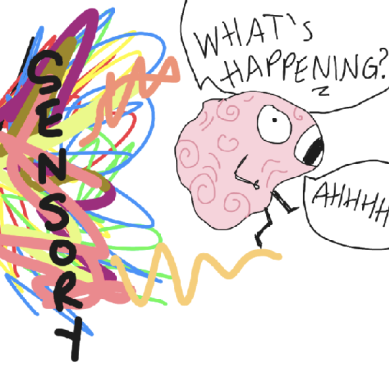
1. SPD, aka Sensory Processing Disorder (which I write about for pretty much every post) is a neurological problem where the brain’s sensory system does not function correctly. Meaning, when you perceive something in the form of sensory info, the brain is all “WTF.”

Picture 33Picture 35

Picture 37


SPD involves your SENSES, your vestibular system, proprioception, motor control, balance, and spatial awareness. There is a dysfunction in the actual processing of sensory information.


2. HSP, aka Highly Sensitive Person, is a “character trait” created by Dr. Elaine Aron. As much as 20% of the population, she believes, has this trait which makes them a highly sensitive type of person. What does this mean though?

HSP’s are very in-tune with their environment. They are overwhelmed by the world in general, specifically emotional situations, and they often struggle to watch or read violent/upsetting things. They are considered shy, quiet, introverted, and anti-social. They are deeply moved by music, art, nature, and all things beautiful.

Here’s the important part: HSP’s also have a problem with sensory info, as it can overwhelm them. They can be sensitive to noise, light, touch, taste, etc. They can become overstimulated and need to withdraw from the world to recoup.

This trait for sensitivity is so closely related to Sensory Processing Disorder, that Dr. Aron also refers to HSP as SENSORY PROCESSING SENSITIVITY. 

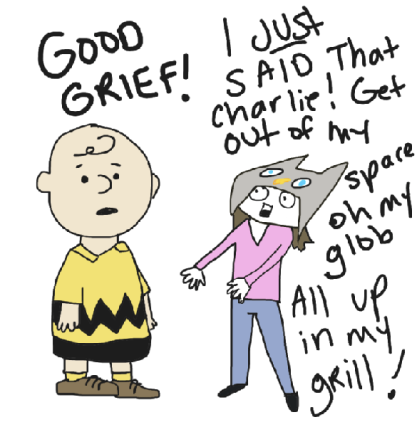
Good grief! Now you can see why Sensory Processing Disorder and Highly Sensitive Person are often confused.
Picture 41


Here is – what I believe to be – the difference:

I think Highly Sensitive People DO NOT have issues with balance, motor control, or body-spatial awareness. Their sensitivities are usually less, but more specific, meaning, they might be sensitive to a certain type of food, or a certain texture of clothes. The bulk of their sensitivities are more abstract, emotional sensitivities.

Their sensory system is probably not dysfunctional, rather, their brains are in a constant state of hyper-awareness and the world can become all too much…all the time. They are sensitive.

If a person is deeply disturbed by emotionally charged situations, or too much socializing, or being in a crowded room, I do not believe they have SPD. They are a HSP.

—————————————-

To make things more confusing, people can be BOTH SPD and HSP. I know this because I am both.

Picture 39

Now you’re thinking “Kelly, you’re crazy. You’re a crazy girl.”

And I’m like: “yea. YEA I AM.”

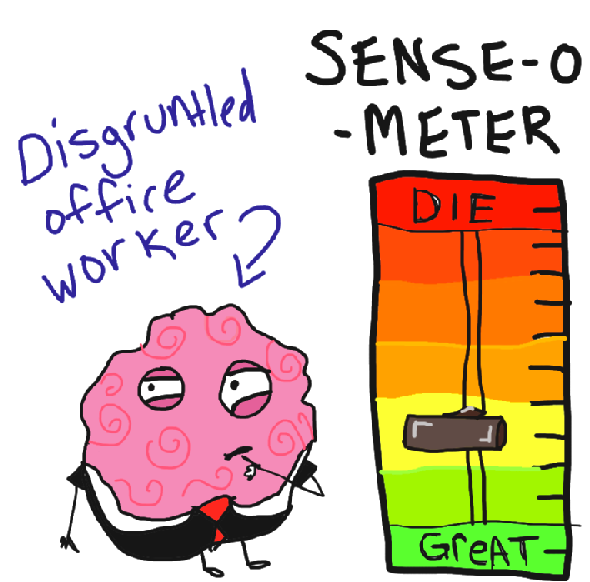
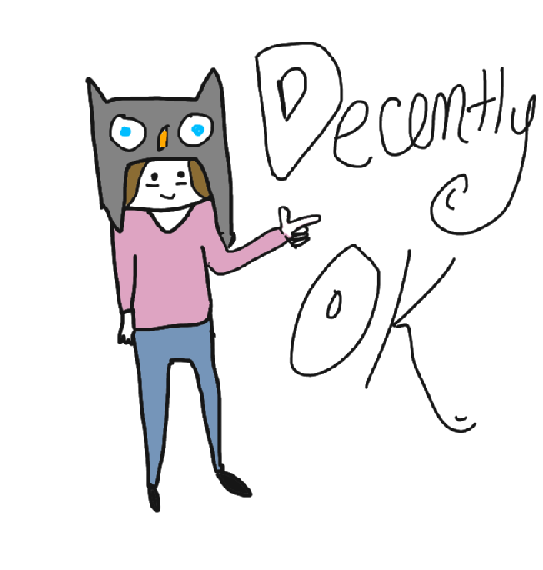
It’s ok to be both. I have both, and I’m decently ok.

Picture 40


I have learned to separate  what I’m feeling and experiencing with SPD and HSP. I know the bulk of my overstimulation is SPD, and I know the sensations I feel that are a result of too much sensory junk because I feel spacey and unbalanced. I need to do my sensory exercises and sleep it off. This is SPD.

I also know when I am overwhelmed and upset by other things, like being around an angry person. I am overwhelmed by their intensity and I cannot separate myself from them emotionally. I need to get away from them and distract myself, or their emotions will make me ill. This is HSP.

———————————————————-

What bothers me, and what I feel is not ok, is to assume a diagnosis of SPD when really, you’re just:

“I’m don’t like arguing or the smell of mustard. Country music makes me angry. I am introverted. I have SPD.” No, bro. You are probably a highly sensitive person.

“Loud noises make me cry, as do sudden bright lights, and I can’t spend more than an hour in the supermarket because I feel spacey and floaty. I don’t like to wear any clothes because they all make me want to crawl out of my skin, and I’m always bumping into things like a drunk weirdo. I have SPD.” Yes, bro. YOU PROBABLY DO.

Moral of the post: If you feel like you have Sensory Processing Disorder, GO TO AN OCCUPATIONAL THERAPIST. Get yourself a proper diagnosis. BUT, before you do so, look into Highly Sensitive Person traits, and perhaps you will find that you are more of an HSP and not SPD. It will save you a lot of trouble (and money). SPD is a disorder, HSP is a sensitivity/trait.

Here is the website for Highly Sensitive Person info: hsperson.com

As usual, feel free to post comments/discussion/ sappy love messages in a reply to this post.

Peace Out homies xoxo

kelly


Partying with SPD

Ask any person with sensory issues about how much they like going to parties.

Oh wait, you don’t have to, I’ll tell you for them. They don’t like it.

Large social gatherings are basically the OPPOSITE of the bees knees for SPDers (well, like 98% of us).

I was at a family/friends party recently. There were about 25 people there of various ages. I spent a lot of my time outside (because outside is usually better than inside because sound has no walls to bounce off of).

But then I came inside….for cake. Everyone was watching the world cup on the tv.

Of course, having impeccable timing like I always do, one of the teams scored a goal at that exact moment, and the house erupted in a roar of whoops and clapping. One of the party goers was clapping so forcefully that I felt as if he was slapping the side of my face with a piece of plywood. Oh yes, it was fun.

That was all I needed. I froze as my sensory system tried to understand what the heck just happened.

Picture 48

Things went downhill quickly. Thankfully, my mom was nearby and witnessed the trauma as it unfolded. She quickly removed me from the scene:

Picture 50

Meanwhile, my body moved zombie-like alongside her, unable to really process much of anything. Amazingly, I did not cry. AS usual, my body deals with trauma by zoning out, crying, and/or going full t-rex (which you can read about HERE). This time, however, I just zoned out.

Picture 63

Mom and I had to then walk down a very steep hill to get away from the noisy, chaotic house party. As we walked, she joked about when my t-rex arms would appear. So I started making dinosaur noises and humming the theme song to Jurassic Park.

Picture 51

It was all fun and games until we had to go from steep hill to steeper driveway. Mom was in heels, and it wasn’t pretty:

Picture 52

MIRACULOUSLY, we made it down to the street where we found a nice little path to walk on….a flat path.

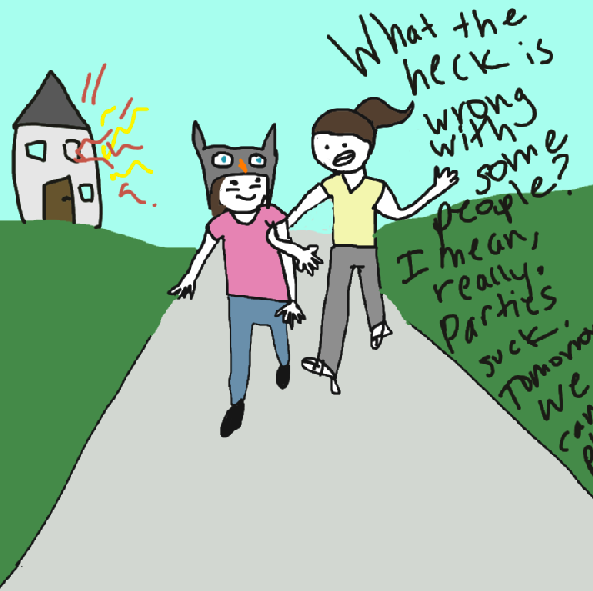
The combination of the air, walking, and having my mom to support me (no really, she was actually holding me upright) started to make me feel less like I was going to die. She started verbally bashing people, parties, society, etc…and it was funny.

Picture 54

Even when we came across a barking dog, and I wanted to destroy him forever,  mom didn’t miss a beat:

Picture 55

(NOTE: I would never wish a dog to die, but when I’m overstimulated, I can’t tolerate anything and become a vicious beast).

As we made our way back to the party, I decided to sit on the front porch steps and mom said she was going to bring me some cake. She said it would make me feel better. She came out holding what appeared to be the majority of the whole cake squished onto a little paper plate:

Picture 56

Of course, she was right. I felt so much better after eating all that ice cream cake. Food for the SPD soul. This post wouldn’t be complete without mentioning that the cake had blue icing on it that stained our teeth bright blue, so we both looked like this:

Picture 58


So that’s my party story.

Moral of today’s post: If you’re going to a party, especially where there will be loud, obnoxious people who will unknowingly destroy your will to live, make sure you bring a SPD friend or caretaker, such as MOM, who can carry out to safety and give you large pieces of cake.

Picture 53


Thanks, Mom.

xoxo kelly

I AM THE T-REX

So there’s this funny thing that happens to me when I experience sensory overload. Apparently I’ve had it for quite some time now, but I’ve only just given it a name and I’m working on stopping it. Sort of.

I call it, T-REX. It sounds way cooler than it actually is.

When I am over-stimulated, I struggle with what’s called proprioception. This is the ability to be aware of my own body movements and my spatial orientation, or position of my body and limbs.  In other words, it’s the ability of me knowing where my body is and what it’s doing. People with sensory difficulties may struggle with proprioception, although it’s not usually discussed because it’s not something general (like sound, touch, taste, etc).

In any case, when I experience this, my body and brain attempt to fix my sensory issues on their own and it doesn’t always work out so well for them.

It’s like when your husband says to you, “Honey, I’ll fix that leaking faucet even though I’ve never done so before but I totally can do it anyway.” The next thing you know, the faucet has exploded and there’s two inches of water in your home. Your husband put some duct tape around it and it’s “good enough I guess.” It has stopped leaking, but it’s certainly not fixed.

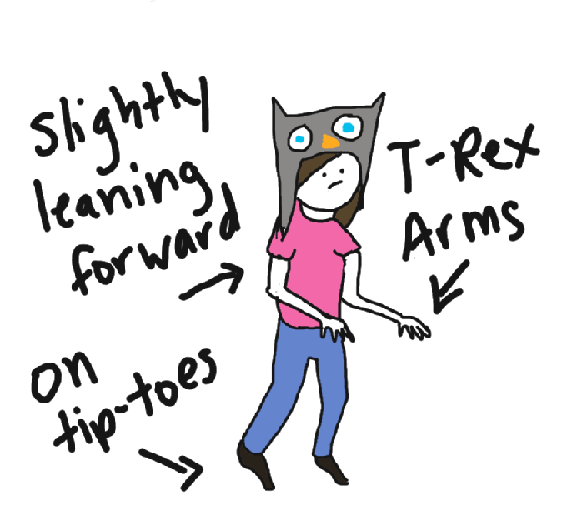
When my brain and body are over-run with sensory junk and they fail to fix it, they use their own version of duct tape. My brain tells my body to contort into the position of your average, everyday tyrannosaurus rex. It looks a little something like this:

Picture 8

Not only is this embarrassing, but I have no awareness of doing it. When I try to change my position, it’s extremely difficult if not, impossible. The T-rex pose is the only way my body and brain have decided to put a temporary fix on a problem they cannot seem to solve. I can only assume this pose comes from my brain trying to find balance.

When my mom and I are out together and she sees me doing this, she whisper/yells “T-REX. T-REX. T-REX.”

My mom then suggests that I try to change my arm position into a more normal-looking one. She says, “swing your arms!” But my arms refuse to. Instead, they swing in unison and I look even worse. It gets me weird looks and small children cry at the sight of it.

Picture 9


When all else fails, I must embrace it. I become the T-Rex, I AM THE T-REX.

Picture 11


xoxo kelly


SPD vs just being sensitive

I have found that there appears to be a bit of confusion as to what it means to be sensory sensitive.

This confusion comes in many forms.

One area of confusion is often with children. I have read about and seen several instances where children display very poor behavior and their parent(s) explains that they have a sensory processing disorder (or something of that nature). While I don’t doubt that children with sensory sensitivities are prone to tantrums, meltdowns, and strange behavior or movements, SPD is becoming the name given to out-of-control children as an excuse for their behavior.

For example, I was in a bookstore and there was a young boy running around, making too much noise, taking things off the shelves, and generally causing mayhem and not caring what his mother had to say about it. I overheard his mother tell someone, “Well, he has the sensory processing thing, so…”

ok.

Who knows. Maybe this four year old boy did have sensory issues, but that shouldn’t be the excuse for his unruly behavior. Unfortunately, I see this a lot. It is becoming a default diagnosis for badly behaved children who don’t fit into other categories. It sounds like this:

“Your child likes to throw and break stuff? SPD.”

“Your child doesn’t listen to you at all? SPD.”

“Your child screams and punches you? SPD.”

This is very scary, considering the fact that I know how real SPD is, and that there are many children and adults with it, yet, it is becoming very much like ADHD in that it is being overly-used to compensate for lack of decent parenting or other issues in children. Then what happens is that people who DO have sensory issues are not taken seriously by the medical community.


The second area of confusion I’ve noticed is that there are people who don’t understand the concept of SPD and claim that every little thing that bothers or annoys them is because of a sensory processing issue. This is not true.

So let me give you a little demonstration:

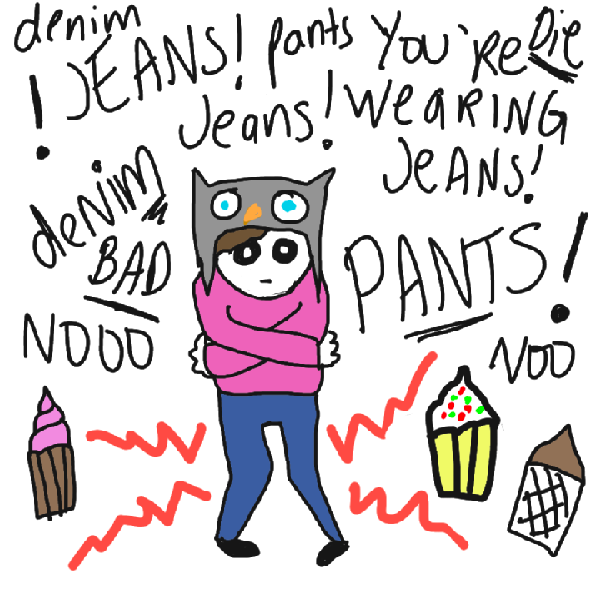
Person WITHOUT SPD (a generally sensitive person):

Picture 5

TWO SECONDS LATER….

Picture 8


Person WITH SPD (a person with a sensory disorder):

Picture 9

TWO SECONDS LATER….

Picture 11


Can you see the difference?

A person who is generally sensitive to things may be bothered by something, but they have the ability  to push that sensitivity into the back of their mind. It no longer bothers them, and maybe they notice it….but they have the ability to remain calm and focus on other things despite this sensory annoyance.

A person who has SPD cannot stop perceiving sensory input (unless you are a hypo-sensitive person who needs MORE sensory input, than this little bit doesn’t apply to you, but you get the gist). The jeans are more than uncomfortable – they are disturbing and nothing else matters (NOT EVEN CUPCAKES) because my brain cannot stop being upset with the sensation of denim jeans on my legs. I cannot focus on anything else, and I definitely do not feel calm.

The latter story ends something like this:

Picture 21


I hope this post has helped clarify the difference between being annoyed by a sensation, and having a sensory problem. As usual, comments or discussion is welcome!

Also, here’s me and a giant cupcake:

Picture 22


-xoxo kelly

Occupational Therapy Adventure (for SPD)

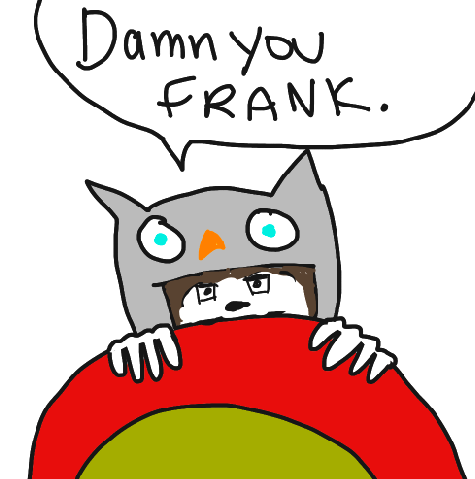
Back in the glorious and confusing days of my childhood, I went to see an occupational therapist once a week to help with my sensory integration/processing disorder. His name was Frank, and he was a young guy who was extremely good looking (and now I CURSE myself because I never appreciated his attractiveness). I was obviously too distracted by the fact that I was 9 years old and more interested in the candy I received at the end of the session. Here’s a picture of Frank:

Picture 59

Alright, so that’s not exactly him.  It’s just a picture of a hot, shirtless guy I found on google, but let’s all pretend this is Frank.

————————— *————————–

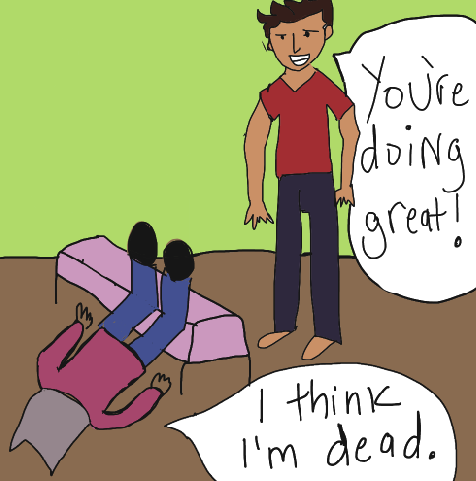
Frank and I did LOTS of things in our short time together each week. He made me walk across a balance beam. This was to re-orient my vestibular system. I hated that. Frank would counter with some sort of ‘comforting statement’ like, “You’re only 2 inches off the ground.”

Picture 60

Not very comforting Frank. Your charm and wit didn’t amuse me.

Picture 61

Then he made me stick my hands in some glue and junk. We turned it green using dye, because why the heck not? It is very hard to describe to people who don’t have a sensory problem how it feels to do something that bothers your sensory problem, like sticking your hand in an icky substance. All I knew was that it was more than uncomfortable, and it created ugly signals in my brain. Therefore, I hated that too.

Picture 63

Picture 62

Sometimes he would suggest that I take a trip through the rainbow tunnel. You know the kind – a small, plastic tunnel that most children enjoying crawling through.

Picture 65

Not me though. My sensory system interpreted small, unfamiliar spaces as threatening:

Picture 66

Picture 67

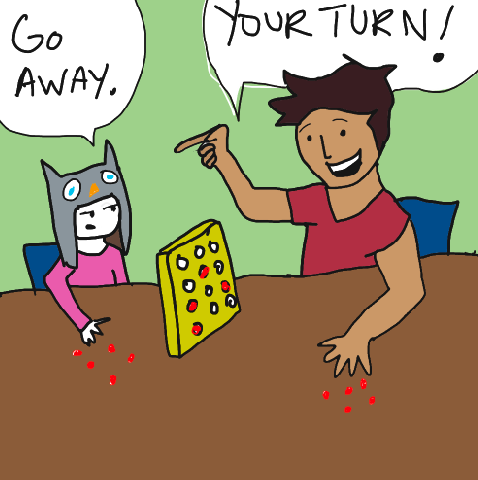
Then we played a stupid game, Connect Four. (Though not as stupid as the game I wrote about in my last post, Operation). I hated this the most because the sounds of the game were sudden and unpleasant. “This game is the pits,” I casually mentioned to Frank.

Frank chuckled at my statement, rested his perfectly featured face upon his hand, and encouraged me to finish the game. I couldn’t wait to tell my mom that she was paying a man to watch me play games that I didn’t even like. UNBELIEVABLE!

At this point of my OT session, I was slightly irritated with Frank. His smiley-ness and optimism was all too much for one girl to take.

Picture 64

But it was not over yet. Before my OT session with Frank ended, he would spend the last several minutes doing joint compressions (pressing my joints in gently) and brushing. The brush looks like this:

Sensory-Surgical-Brush1

It’s kind of FANTASTIC. (Although, those without sensory deep-pressure needs may find the brush against their skin to be unpleasant or just weird).

But who cares about those people, this brush is wonderful. After some deep pressure exercises, brushing, and joint compressions, I felt like a new girl. My hatred for Frank and his gorgeous smiling face seemed to vanish. Things got a little freaky:

Picture 68

Finally at the end of the session, I received my candy of choice and went on my merry way. This lasted for a few weeks or so, possibly longer, I don’t actually remember.

What I do remember is the absurdity of it all, and yet, my strange willingness to comply. I continued the compressions and brushing at home, but I don’t think that alone was enough to counteract the intense over-stimulation I was experiencing daily at school. Still, it was something, and definitely an experience I will never forget.

-xo Kelly

Why Operation is the Weirdest Game Ever

I don’t know about you guys, but during my childhood there was one game that I absolutely despised playing: The game of Operation.

You all know it. The creepy naked dude with his internal organs exposed for children to poke at and remove for their selfish pleasures. Yes children, harvest the organs! HARVEST THEM.

But, that was not the worst part of the game. The terror was in the removal of the organs themselves. For if you didn’t do a decent job during the surgery, a loud and sudden buzzing sound would be released from the man’s body like it was his own bloody screaming.

As a child who was terrified by basically everything, and saw everything very seriously and realistically, this game was absolute horror.

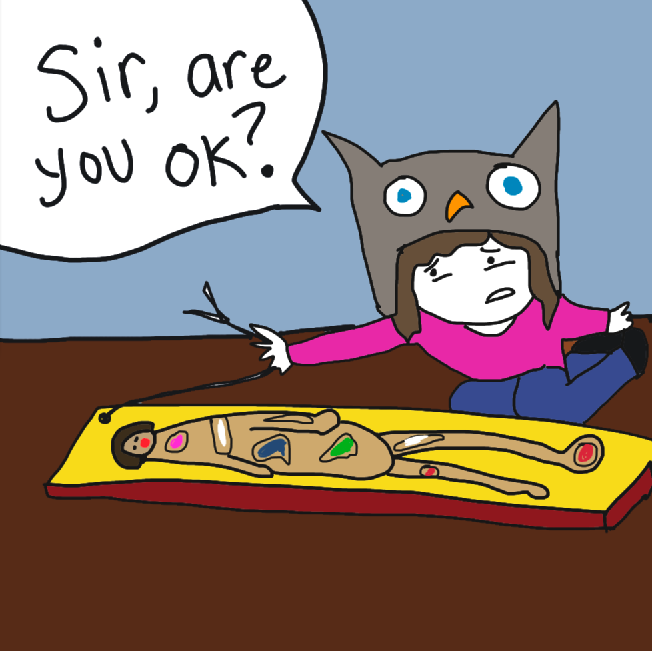
Picture 15

Picture 17

What a nightmare.

Let’s look closer….

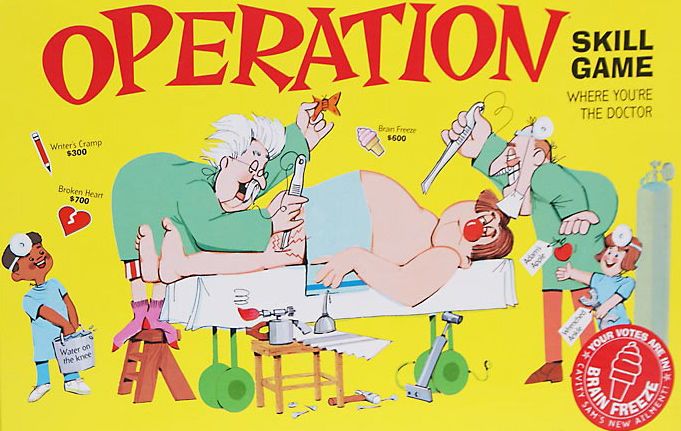
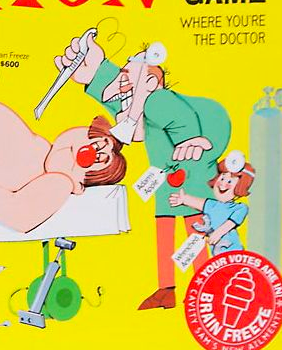
Here’s the box – it always freaked me out as a kid. Firstly, the dude on the table is AWAKE. Perhaps slightly drowsy, but definitely conscious. Naturally, I felt bad for him, and the pain he must have been experiencing during the game. For the sake of this post, let’s call this guy Norm.

operation-board-game

Norm clearly has a lot of medical problems, as demonstrated by the outrageous amount of surgery being done.

Looking at the box, we can see Norm with his inflamed red nose (which by the way is NOT addressed as a problem for him in the game). Does anyone care about Norm’s obvious nose issues?! No, no they don’t.

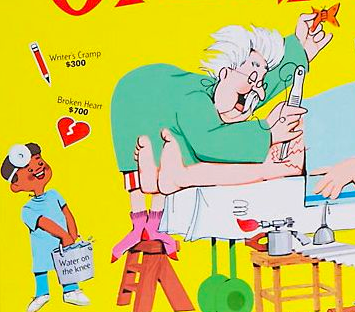
On the left, we have Einstein – in pink socks and red striped boxer shorts – holding a butterfly in one hand while jamming a ginormous metal device into Norm’s thigh.

Picture 10

Apparently pants aren’t required when you’re a surgeon. Also, he is unnecessarily standing on a tiny ladder. The whole procedure is disturbingly close to Norm’s crotch. Yes, I said it. You all noticed it too.

Behind Einstein is a small, cheerful boy holding a bucket of water and staring directly into Einstein’s butt. No further comment on that one.

Moving to the right, we have a taller fellow who looks like Ferris Bueller’s principal, Mr. Rooney.

Picture 11

This must have been his after-school job. Mr. Rooney appears to have serious back issues, but at least he’s wearing pants and shoes. And look! A face mask! …..not on his face though. SO CLOSE ROONEY! Below him is a happy little girl holding a very large weapon.

Picture 8

But it only gets weirder my friends! The game looks like this:

operation_game

Norm not only has a serious nasal condition, but also, terrible hair.

I’m going to point out the weirdest thing here: why on earth are we supposed to remove things like ice cream cones and butterflies and apples from this poor man? I get the creativity here, but from my childhood experience, it was all very disturbing.

Here I was, a young girl, expected to remove absurd objects from Norm’s naked body with a pair of giant tweezers while he looked up at me with that hairdo. I knew it was a stupid game, but I couldnt’ help but take it very seriously and the buzzing sound gave me tremendous anxiety. It wasn’t exactly a sensory-fun game.

None of my friends seemed to understand the fear.

Picture 12

Picture 13

(p.s. I loved my friends)

So there you have it. Operation is an irrational game where children are asked to pull foreign objects, like ice cream cones, from a naked man with a nose deformity.

May this game never see the light of day again.

xoxo ~Kelly

The Forgotten Component of Autism

There is something about autism that I’ve been going over and over in my head for many years now. I consider it the forgotten aspect of autism, or should I say, the ignored aspect of autism.

I am referring to sensory dysfunction, or sensory processing/integration disorder. Whatever you want to call it, the bottom line is that the sensory problems that are very much present in people across the autistic spectrum are not being recognized by professionals who are treating autism. Actually, they aren’t really recognized by anybody. This frightens me.

I recently graduated with my degree in psychology. During my education, autism was brought up frequently in many of my classes. What was alarming though, was that the information being taught about autism neglected to mention sensory features. In my textbooks and during lectures, I would learn about general autism. You know what I’m talking about: little verbal abilities, communication problems, social deficits, and learning impairment. I would raise my hand and mention the importance of sensory dysfunction in autistic people. The professor would either shoot me down or brush off my comment as not important to the field of autism. My peers never knew what I was talking about.

I began to panic, thinking that this must be a mistake, and that sensory problems were definitely a well known part of autism. I was so wrong.

Picture 17

As I began to research on my own, I discovered that many websites that had information about ASD neglected to include the significance of sensory problems. If you think about it, this is mostly true across the board of autism research. Ask someone what autism is, and they are likely to respond with: communication problems, tantrums, social impairment, nonverbal, etc. (Side note: I am aware that not all people with ASD have sensory problems, and that not all people with sensory problems have ASD, but the link between the two is too obvious to ignore.)

What the heck is going on you guys? I’m seriously concerned here.

The most common problem with autism IS sensory dysfunction, yet, this is rarely mentioned by the medical community and basically unknown to the general public. (Making Sense of Senses by Virginia Hughes, 2009. Link to the article at the bottom of my post).

I’ve heard things like:

“My child hates having things on his hands, like glue.” 

“My sister squints when she is in a bright room and she covers her ears in the mall.”

“This boy doesn’t like to be touched, but he wants to touch everything!”

My argument is that sensory problems are the basis for many of the more well-known aspects of autism, like communication and social impairments, verbal difficulties, learning problems, and most importantly, behavioral problems.

(By the way, a few months ago I read Temple Grandin’s book, The Autistic Brain, and was amazed to see that she basically said everything this post is about: the lack of research on the importance of sensory features. Temple stole my original idea but I’m going to let that slide even though I totally thought of it first). Ok, where was I….

I believe that sensory problems – which are being completely neglected in the field of autism – are responsible for the many problems that are commonly seen in people on the spectrum.

This idea makes so much sense to me because I live it. I KNOW that when my senses are overloaded, the rest of me (my ability to communicate, perform a task, regulate my emotions) is screwed. It is not until my sensory problems calm down that I am able to reorient myself to function.

If we look at the common behavioral features of people on the spectrum, it is clear (at least to me) that the behavior is a direct response to the lack of sensory processing ability. Basically, many autistic behaviors exist because the person is trying to sort out their sensory environment. For instance, the need for routine and consistency is highly valued by autistic people. I think this is because routine equates to predictable sensory environment. There will be no surprises, and we generally hate surprising things.

Self-soothing techniques is another example. To combat the disarray of sensory environment, people on the spectrum employ multiple self-soothing, or self-calming behaviors such as pacing, rocking, hand flapping, verbal repetition, etc.

Looking at autism, I feel it is crucial to focus on the internal processing that is causing the behaviors that are observable. Right now, information about autism and research about autism is so heavily concentrated on changing maladaptive behavior (tantrums, screaming, hand flapping, hyperactivity, etc). Are we forgetting to look at the causes of these behaviors? The fact that these behaviors are occurring because the person with autism is trying to make sense of their dysfunctional sensory processing and their overstimulating environment. It’s time to focus on altering the environment to suit the needs of the person, rather than trying to force the person to adapt to an unsuitable environment. The latter is absurd and is happening all the time. It’s time to focus on treatment for sensory problems, like a sensory diet, which allows the person to know their sensory limits and what to do to alleviate sensory overload.

And that’s my rant. I will most likely write more about this in the future, but I wanted to get this out of my system while I had the free time to do so. Thanks for reading….sorry for the lack of humorous illustrations like in my other posts.

Here is the link to the article, Making Sense of Senses, which I referred to in this post: https://sfari.org/news-and-opinion/blog/2009/making-sense-of-senses

Feel free to comment and share
xoxo
~Kelly~